
Off-grid and backup-ready homes
Your own power, water and heat.
Partly off the grid, fully off the grid, or simply ready when the grid goes down. We plan your power, water and heat together with your house, even on land with no utilities at all.
- Three levelsBackup, partial, full
- Power, water, heatPlanned with the house
- No utilities?We build there too
- Quoted for your landAfter a free feasibility check
01 / Three levels of independence
As independent as you want to be.
Grid-tied with backup
When the grid goes down, your house keeps going.
The grid stays your main supply. Solar and batteries, a backup generator, or both take over when the power fails, so the lights, well pump, fridge and heat keep running.
- Solar and batteries, sized for the essentials or the whole house
- Automatic switchover to battery or generator
- Grid connection kept as your main supply
For land with a power line nearby, when you want independence when it counts.
Partial off-grid
Most of what you use comes from your own land.
Solar and batteries cover most of your power, your own well supplies your water, and heat comes from the sun, wood or propane. The grid is a backup, not a lifeline.
- Solar and batteries sized for everyday use
- Your own well and water storage
- Heat that doesn’t depend on the grid
For homes that want low bills and real independence, with the grid as a safety net.
Full off-grid
No utility connections at all.
Power, water, heat and wastewater are all handled on your land: solar and batteries with generator backup, a well with storage, a septic system, and heat from the sun, wood or propane.
- Solar, batteries and a backup generator
- Well, water storage and septic
- Heat from the sun, wood or propane
For land where the power line is far away, or there isn’t one.
02 / What we plan and build
Power, water, wastewater and heat, from one team.
We plan, size and coordinate every system together with your house, and build it. Licensed specialists handle the work that needs a license, such as drilling the well and designing the septic system, as part of our team.
Power: solar and batteries
Solar panels, battery storage and an inverter, sized from what your house will really use. On a backup-ready home, they carry you through an outage; off-grid, they are your power plant.
Backup generator
A propane or diesel generator for long cloudy stretches and peak loads, switching on automatically when the batteries run low or the grid goes down.
Water: well and storage
A well, water storage and a pressure system, planned with the house. A licensed driller drills the well; we plan the well permit and the system around it.
Wastewater: septic
A septic system (OWTS) designed for your soils by a licensed engineer and permitted by your county, coordinated with the site plan.
Heat: sun, wood, propane, heat pumps
Solar hydronic heat for radiant floors and hot water, wood heat, propane, and heat pumps run by your solar. Usually combined, so the sun does most of the work and wood or propane covers the rest.
03 / Why the plan comes first
Off-grid, every kilowatt-hour you don't need is equipment you don't buy.
On the grid, a leaky house costs you a higher bill. Off the grid, it costs you more panels, more batteries, a bigger generator and more fuel. That's why we start with the house itself: an airtight, well-insulated shell, windows and overhangs placed for free winter sun, and heating sized with a Manual J load calculation instead of a rule of thumb.
Then we size power, water storage and backup to the house you'll actually live in, before the design is frozen, as part of our Build-Ready Package. No guessing, and no systems bought too big or too small.
04 / Land without utilities
No power line, no water main? We start there.
Raw land far from utilities is often the most beautiful, and the hardest to judge. In the free Land Feasibility Check we walk your land and look at what an off-grid home there needs:
Power
How far the nearest power line is, and whether connecting or going off-grid makes more sense for your parcel.
Water
What it takes to get a well permit and water on your land.
Septic
Whether your soils suit a septic system, and where it can go.
Sun
How much sun your building site gets in winter, and what shades it: terrain, trees, neighbors.
Access
A driveway a well rig, propane truck and fuel delivery can use, in winter too.
Wildfire
Wildfire mitigation, where your county requires it, planned together with fuel and water storage.
05 / Going off-grid
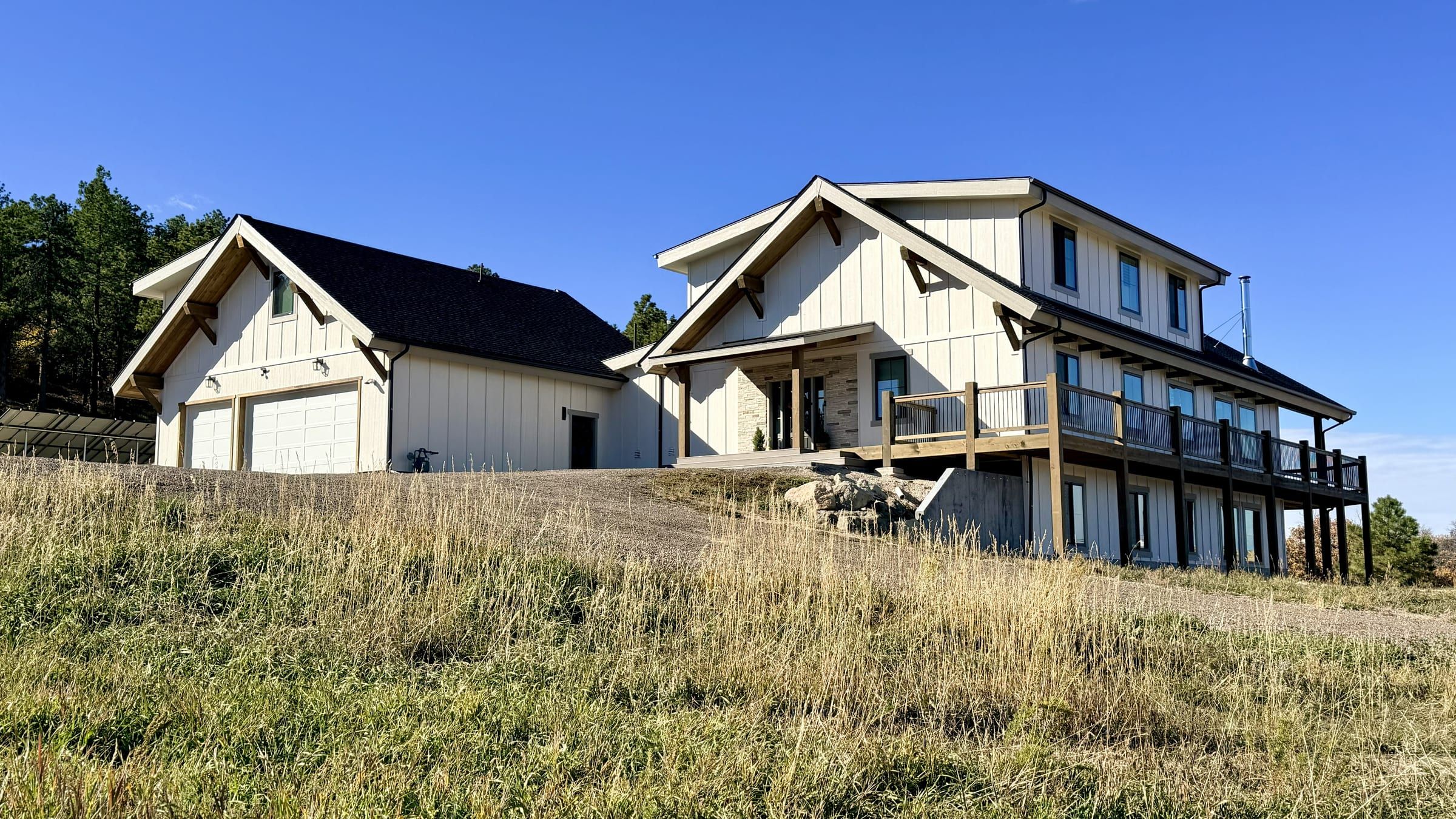
Our net-zero home is going off the grid.
The energy-efficient custom home we designed and built in Douglas County, CO already makes most of its own energy. Now we're taking it fully off the grid, adding propane and wood heat to its solar and batteries.
- Blower door result, less than half the 2021 IECC prescriptive limit of 3.0 ACH50
- 1.34
- ACH50 airtightness
- Solar photovoltaic system (upgraded from the original 9.12 kW)
- 19.68
- kW solar
- Battery storage (upgraded from the original 37 kWh)
- 64
- kWh batteries
Plus whole-house hydronic radiant heat. In progress: the off-grid conversion. We'll share the results here once it's done.
See the project06 / What it costs
Quoted for your land and your level.
Planning the off-grid and backup systems is part of your Build-Ready Package. Because every site and every level of independence is different, we quote that part individually, after the free Land Feasibility Check.
The systems themselves are part of your construction budget, priced line by line before you build, like everything else.
Start with the house
Our calculator shows the standard Build-Ready Package fee for your size of home. Off-grid planning is quoted on top.
Calculate the standard fee07 / Questions
Off-grid, answered.
Will I notice when the grid goes down?
With backup planned in, the switch to battery or generator happens automatically. How much of the house keeps running, and for how long, we decide together in planning: just the essentials, or the whole house.
Can I start grid-tied and go off-grid later?
Yes, if it’s planned for. We leave room for more panels and batteries and prepare the wiring and space, so adding them later is a simple step instead of a rebuild.
Is full off-grid realistic in a Colorado winter?
Yes, with the right plan: an efficient, airtight house, enough battery storage, heat that doesn’t depend on electricity alone (sun, wood or propane), and a generator for long cloudy stretches.
Does off-grid cost more?
The systems add cost to the build. On land without utilities, though, they can cost less than bringing power out to the site. We compare both for your parcel before you decide.
Thinking about land without utilities, or a home that keeps going when the grid doesn't?
Start with a free Land Feasibility Check. We walk your land with you and tell you what each level of independence would take there.